Friday, 8 November 2024

Product Recommendation - [Inverter and Battery]

In this post, we are providing at glance the products we consider to be some of the best offerings in the market in their respective categories. The products mentioned below have been put to rigorous tests, compared against the competing products from multiple brands, and have been analysed on various aspects pertaining to their intended use. For a comprehensive post on Inverters, you may read our detailed guide - https://shoppinaire.blogspot.com/2022/03/a-comprehensive-guide-to-buying-inverter.html

Inverter
Best Choice 1, My Preferred Choice, Best Choice 2, Best Choice 3, Best Choice 4, Best Choice 5, Best Choice 6, Best Choice 7, Best Choice 8, Best Choice 9, Best Choice 10, Best Choice 11, Best Choice 12 and Best Choice 13

Inverter + Battery Configuration
Best Choice 1, My Preferred Choice, Best Choice 2, Best Choice 3, Best Choice 4, Best Choice 5, Best Choice 6, Best Choice 7, Best Choice 8, Best Choice 9 and Best Choice 10

Inverter Battery
Best Choice 1, Best Choice 2
My Preferred Choice, Best Choice 3, Best Choice 4, Best Choice 5, Best Choice 6, Best Choice 7, Best Choice 8, Best Choice 9, Best Choice 10, Best Choice 11 and Best Choice 12

Note: In our constant endeavour to assist you in making an informed buying decision, we test the new launches of the products on multiple parameters, and if they stand tall in our analysis we periodically add them to the below mentioned list of our recommended products. So, if you plan to make the purchase at a later time, you may visit the links once again at the very time of buying to ensure that the purchase turns out to be a very fruitful one.

Recapitulating on the most crucial aspects of buying an Inverter -

ENERGY REQUIREMENT

  • Power requirement of various appliances

This is one of the most crucial factors that heavily influences the Volt-Ampere (VA) rating one should opt an inverter with. Power requirement is the sum total of the individual power consumption of all the electronic appliances one wishes to operate on the inverter in times of outages. Typically, the most essential appliances such as few fans and lights, a refrigerator and a television are a few devices one would require running at all times.

Now, for illustration, we would keep into consideration these few devices that one would require to be in constant operation even in times of power outages and we would analyse the sum total of power consumption and correspondingly determine the VA rating one should aim to choose an inverter with -

4 Ceiling Fans - 75W x 4 = 300W

5 Fluorescent Tube - 50W x 5 = 250W

1 Double Door (3 Star Energy Rating) Refrigerator - 175W (approx.)

1 LED television (42 inches) - 75W (approx.)

Total power consumption = 300 + 250 + 175 + 75 = 800W

Now, if inverters, or any electronic appliance for that matter, operated on 100% efficiency then power supplied by the source and power consumed by the appliances would be equal. However, in reality 100% efficiency does not exist, primarily due to heat losses, and thus inverters operate on about 75–80% efficiency. An extension to the efficiency of an electrical appliance is a term called power factor and is the ratio of power required by an appliance to operate to the power supplied in the circuit.
Thus corresponding to 80% efficiency, the power factor would be approximately 0.8. The final Volt-Ampere (VA) rating one should consider buying an inverter with is found by dividing the Total Power Consumed by the Power Factor.

In our illustration, total power consumption is 800W, thus, dividing it by 0.8 would yield 1000VA. Therefore, the optimal inverter to pick for such kind of load requirement would be the one that has rating of at least 1100 VA.
Now, depending upon the requirement and usage, one can run large appliances such as air conditioners and water geysers on inverter power as well, by deciding on an inverter that has a significantly higher Volt-Ampere (VA) rating.


  • Battery capacity

Battery backup is one of the pivotal aspects of owning an inverter. The time period for which a battery can provide power to the electronic appliances in absence of power outages depends on three factors - battery capacity, voltage of the battery and total power consumption.
Majority of the inverter batteries have a nominal voltage rating of 12V. Now, to illustrate, we would consider the power consumption of 800 W which we calculated before. Typically, power outages can last from about few minutes to several hours, and again, this depends highly on the locality as well. Therefore, for proceeding with the analysis, we would assume that a typical power outage lasts for approximately 4 hours.

So, to calculate what capacity of battery one would require under the given circumstances, there is a rule of thumb -

(Power consumption) x (Battery backup) / (Voltage of the battery)

i.e. (800W x 4 hours) / 12 volts = 266.67 Ampere-hours

For the considered power consumption and duration of power outage, a 266.67 Ah battery would be required, which can be easily constructed by connecting two 150 Ah batteries in parallel.
For various power consumption requirements, batteries of numerous Ampere-hour ratings are available in the market. Depending upon requirement, one may use the battery individually or connect two or more of them in parallel to increase the power backup times.

Now, having examined the several factors that assist in determining the specifications of the inverter and its battery, let us proceed to understanding the ways in which some manufacturers (names not taken) try to cut manufacturing costs in order to maximize their own profits and in turn deliver a sub-standard product to the customers, the components of which have a very short shelf life and may require frequent repairs/replacements.


COST CUTTING TECHNIQUES

  • Low-grade cooling fan. As discussed previously, electronic appliances do not operate on 100% efficiency. Most appliances function at 80% efficiency, the remaining 20% is lost to heat. In case of inverters, a high quality and potent fan is required to keep the inverter circuitry from overheating and keep functioning at optimal temperature. Unfortunately, most buyers do not pay attention to the cooling fan deployed in the inverter, and this gives some manufacturers a perfect opportunity to increase their profit margin and make use of an inferior cooling fan that is very inept in keeping the temperatures within the inverter casing in permissible range. As a result, over a period of few months, the excessive heat causes the components of the inverter to malfunction and finally melt, causing the entire unit to be non-operational. Cost of repairing the inverter might range from a few hundred bucks to more than a thousand bucks and this process is recurring.
  • Overstated Voltage-Ampere rating. In order to reduce manufacturing costs further, some manufacturers resort to exaggerating the VA capacity of the inverters they manufacture so as to lure innocent customers. However, obtaining near absolute power output from the inverter requires use of high quality components that have near ideal resistance and impedance, which again add to the initial cost. So, in order to keep the initial cost of the product low so as to attract buyers, those manufacturers make use of components that have higher impedance values which leads to loss of efficiency to heat. As a result of which, the inverter tends to beep continuously, displaying overload warning and trips just when the load reaches slightly higher than 65-70% of the stated Volt-Ampere rating.
For an extensive buying guide on Inverters, head over to our detailed post - https://shoppinaire.blogspot.com/2022/03/a-comprehensive-guide-to-buying-inverter.html

Wednesday, 6 November 2024

Product Recommendation - [Air Purifier]

In this post, we are providing at glance the products we consider to be some of the best offerings in the market in their respective categories. The products mentioned below have been put to rigorous tests, compared against the competing products from multiple brands, and have been analysed on various aspects pertaining to their intended use. For a comprehensive post on Microwave Ovens, you may read our detailed guide - https://shoppinaire.blogspot.com/2024/11/a-comprehensive-guide-to-buying-air.html

For coverage area up to 400 square feet

Best Choice 1My Preferred ChoiceBest Choice 2Best Choice 3Best Choice 4Best Choice 5 and Best Choice 6 


For coverage area in the range of 400 to 750 square feet

Best Choice 1Best Choice 2My Preferred ChoiceBest Choice 3Best Choice 4Best Choice 5Best Choice 6 and Best Choice 7


For coverage area beyond 800 square feet

Best Choice 1Best Choice 2My Preferred ChoiceBest Choice 3Best Choice 4Best Choice 5 and Best Choice 6


Note: In our constant endeavour to assist you in making an informed buying decision, we test the new launches of the products on multiple parameters, and if they stand tall in our analysis we periodically add them to the below mentioned list of our recommended products. So, if you plan to make the purchase at a later time, you may visit the links once again at the very time of buying to ensure that the purchase turns out to be a very fruitful one.


Recapitulating on the most crucial aspects of buying an air purifier -

  • Clean Air Delivery Rate (CADR)

  • For installing the air purifier in a bedroom having area up to 350 square feet, go with an air purifier that provides a coverage area of at least 370 to 400 square feet with the CADR value between 150 to 250 metre cube per hour. 
  • For installing the air purifier in the living room having area in the range of 350 to 700 square feet, purchase an air purifier that provides a coverage area in the range of 400 to 750 square feet with the CADR value of 250 to 350 metre cube per hour. 
  • For installing the air purifier for purifying the entire house i.e. for areas beyond 700 square feet, go with an air purifier that provides a coverage area in the range of 800 to 1200 square feet with the CADR value of 400 metre cube per hour and beyond. 
  • COST CUTTING TECHNIQUES
      • Using a below par HEPA filter. For its paramount importance, HEPA filter accounts for almost 30% of the entire cost of the air purifier. Hence, in order to reduce production costs and to maximize profits, some manufacturers resort deploying a poorly fabricated and inefficient HEPA filter in the air purifiers they manufacture, that is not potent enough in trapping the numerous allergens present in the air and hence the contaminants stay unaffected in the air one breathes that may lead to development of respiratory diseases including bronchitis, lung cancer and asthma.
      • Using a low grade fan. The effectiveness of an air purifier depends upon the speed settings of the fan and the wattage of the motor. Now, what some brands do is, they show a higher capacity of the air circulating fan on paper, so as to fool the innocent buyers. However, in reality the fan speed of such air purifiers is extremely low and thus the clean and purified air is not able to circulate to a large area which in turn leaves the air in the far off spaces unclean and full of harmful disease causing allergens.
    For an extensive buying guide on air purifiers, head over to our detailed post - https://shoppinaire.blogspot.com/2024/11/a-comprehensive-guide-to-buying-air.html

    A comprehensive guide to buying an Air Purifier

    Air pollution has become one of the most serious issues of the 21st century. With rapid industrialization and urbanization, one thing that has taken the most brutal hit is the nature: the environment. With modernization comes luxury, with luxury comes comfort and what could be a better example of comfort than having a personal car? After all, who likes to travel in the public transport by choice, isn’t it?

    Since most urban cities nowadays have two or three earning members per home so affording a car isn’t that difficult. In fact, the report released by the Delhi government shows the number of registered vehicles increased from 8.8 million in 2014-15 to 9.7 million in 2015-16 — a spike of 9.93% and the highest in eight years.

    What these alarmingly high figures of cars running on the roads illustrate? It illustrates the quality of air that is going into our lungs with every breath. According to an IIT-Kanpur report, toxic exhaust fumes from vehicles constitute 25% of the city’s air pollution. The latest government data shows 6,502 people died of respiratory diseases in 2015, making it one of the leading causes of death.

    This is when an air purifier comes to the rescue..


    Now, if you are a frequent visitor to the posts on this blog, you might be probably aware that we take each topic from the grass root level and we will do the same with this post as well. We will begin with the basics first, understand how an Air Purifier works and the various types of filters that are deployed in air purifiers, then we’ll proceed to understand what Clean Air Delivery Rate (CADR) value of the air purifier should one go for depending upon the room size and the coverage area. After that, we will move on to discuss how some brands cut costs and manufacture below par products that are very inefficient in keeping the air clean and purified and hence pose a threat of contracting respiratory disorders and then we will proceed onto deciding which air purifier would be the best for you, according to your needs.

    You might be glad to know that my father works at a company that manufactures home appliances like refrigerators, air purifiers, kitchen chimneys, washing machines etc. So at home, we frequently have a conversation about commercial appliances, what goes into making them, how brands try to do cost cutting etc.

    Today, I'll try my best to pass on the knowledge that I have acquired from my father over the years, to you so as to help you make a good buying decision.

    So without further a do, let’s begin…

    The Basics

    There are multiple allergens in the atmosphere including smoke, dust, pollen grains, bacteria, viruses etc which can not be seen with the naked eye but are extremely damaging to the lungs and the immune system. The air inside a typical home is generally dirtier than the air outside, because a house can be a source of air contaminants. Moisture can lead to the development of molds and spores then air conditioners circulate the dust particles and bacteria throughout the house. Pollen grains and other outdoor allergens can blow in through open doors and windows and become caught in carpet or bed sheets.
    Air purifiers filter allergens and pollutants which may or may not be visible to the human eye. To remove these allergens, air purifiers typically use filters.

    Some of the most commonly used filters in an Air Purifier are:-
    1. HEPA
    2. Activated Carbon
    HEPA Filters
    A HEPA or the High Efficiency Particulate Air is a type of mechanical air filter; it works by forcing air through a fine mesh. The fibers of the mesh are typically composed of fiberglass and are remarkably effective in trapping contaminants above 0.01 microns. This makes air purifiers a great proposition to control the indoor spread of SARS-CoV-2 virus responsible for the Covid-19 pandemic as the size of the virus is 0.125 microns, that falls squarely within the particle size range that HEPA filters eliminate with extraordinary efficiency. Other contaminants that a HEPA filter effectively traps are bacteria, fungi, smoke, dust, pollen grains, etc.
    To put it simply, HEPA filters trap air contaminants in a complex web of fibers. Depending on the size of the particle, filtration of contaminants happens in the following ways:-
    • Inertial Impaction and Sieving
    • Diffusion
    • Interception
    Larger contaminants are trapped via inertial impaction and sieving. The particles either collide with the fibers and get trapped or are trapped while attempting to travel through the fibers.

    Medium sized particles, as they move through the filter, are grabbed by the fibers via interception.

    Smaller particles are dissipated as they travel through the filter and eventually collide with a fiber and are trapped.
    (Image of the working of the HEPA filtration mechanism)

    Activated Carbon Filters
    Activated carbons are small pieces of carbon, typically in granular or powdered block form, that have been treated to be extremely porous. Vast surface area of the activated carbon enables these filters to adsorb exponentially more contaminants and allergens than traditional carbon. Contaminated air enters the filtration system, passes through the active carbon, undergoes adsorption, and leaves the filter after getting purified.

    Adsorption is a process where organic compounds in the air react chemically with the activated carbon, which causes them to stick to the filter. The more porous the activated carbon is, the more contaminants it will capture. The activated carbon filters work in collaboration with the HEPA filters to get rid of unpleasant odors and the other harmful allergens discussed above.

    Apart from the filters, some air purifiers make use of other technologies like negative ionization, ozone emission and UV filtration. However, these technologies work well for countries where the air quality is much better unlike India where you find very dense and high particulate pollutants i.e. the PM 2.5 which is extremely harmful for the living beings.
    Image result for air purifier in room
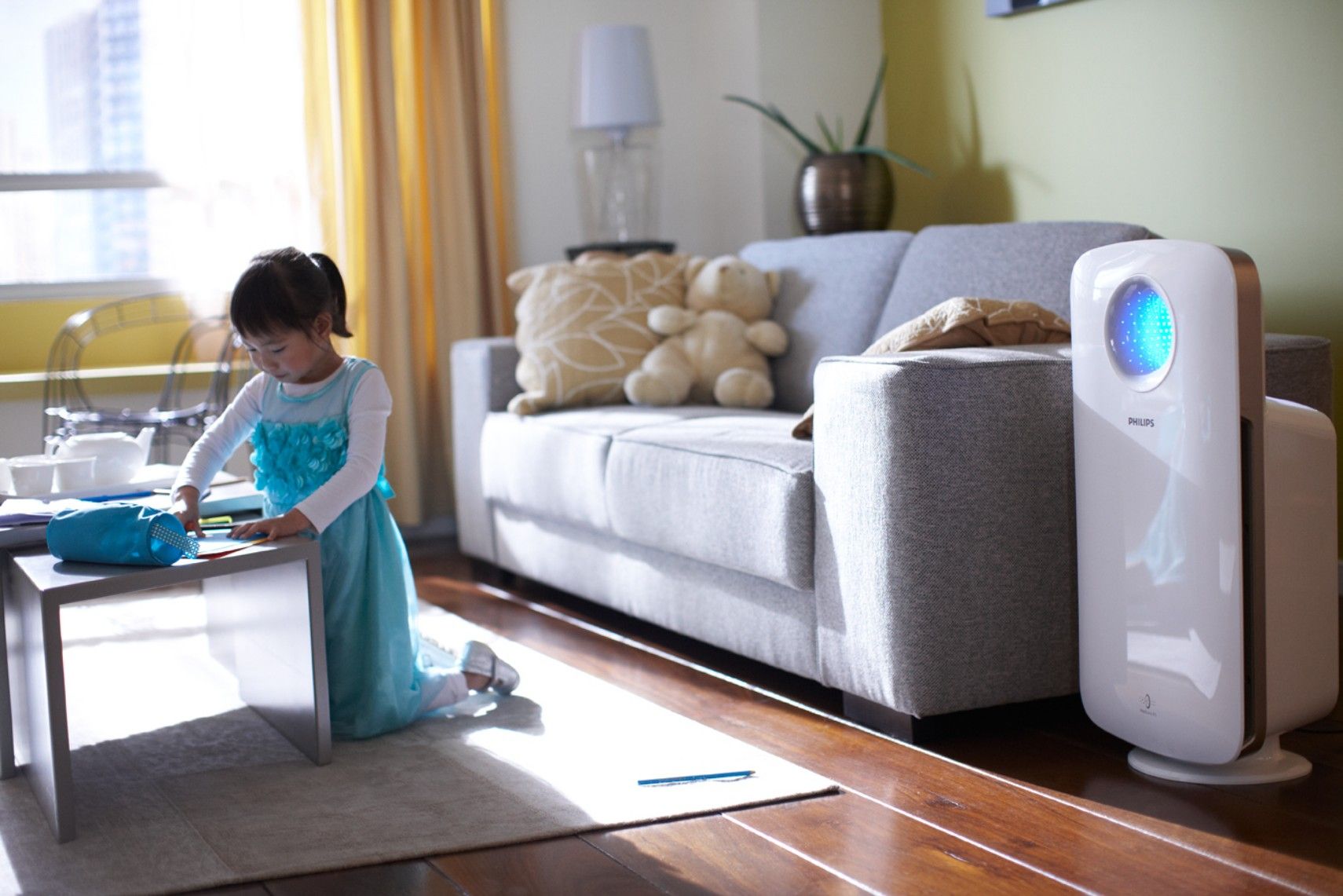
    (Image of an Air Purifier )

    Now, having learnt about the working of the air purifier and the various filters that are used in it, let’s proceed to learn what Clean Air Delivery Rate (CADR) value of the air purifier should you go for depending upon the area of the space that you wish to purify.
    • For installing the air purifier in a bedroom having area up to 350 square feet, go with an air purifier that provides a coverage area of at least 370 to 400 square feet with the CADR value between 150 to 250 metre cube per hour.
    • For installing the air purifier in the living room having area in the range of 350 to 700 square feet, purchase an air purifier that provides a coverage area in the range of 400 to 750 square feet with the CADR value of 250 to 350 metre cube per hour.
    • For installing the air purifier for purifying the entire house i.e. for areas beyond 700 square feet, go with an air purifier that provides a coverage area in the range of 800 to 1200 square feet with the CADR value of 400 metre cube per hour and beyond.
    In addition to this, what one must ensure is the level of noise produced by the air purifier when in use is under permissible limits. As a rule of thumb, noise levels below 60 dB are considered safe for prolonged use.

    Having said that, let’s proceed to learn how some brands (names not taken) cut manufacturing costs to maximize their profits and in return provide an inefficient product to the consumer which can cause irreversible damage to the consumer’s health.
    • Using a below par HEPA filter. For its paramount importance, HEPA filter accounts for almost 30% of the entire cost of the air purifier. Hence, in order to reduce production costs and to maximize profits, some manufacturers resort deploying a poorly fabricated and inefficient HEPA filter in the air purifiers they manufacture, that is not potent enough in trapping the numerous allergens present in the air and hence the contaminants stay unaffected in the air one breathes that may lead to development of respiratory diseases including bronchitis, lung cancer and asthma.
    • Using a low grade fan. The effectiveness of an air purifier depends upon the speed settings of the fan and the wattage of the motor. Now, what some brands do is, they show a higher capacity of the air circulating fan on paper, so as to fool the innocent buyers. However, in reality the fan speed of such air purifiers is extremely low and thus the clean and purified air is not able to circulate to a large area which in turn leaves the air in the far off spaces unclean and full of harmful disease causing allergens.

    Now, having learnt how some air purifier manufacturers cut costs, let’s proceed to zero down on some of the best built air purifiers available in the market that are not only the best in their air purifying prowess but are also energy efficient in their working and offer the most value for money.

    Note: In our constant endeavour to assist you in making an informed buying decision, we test the new launches of the products on multiple parameters, and if they stand tall in our analysis we periodically add them to the below mentioned list of our recommended products. So, if you plan to make the purchase at a later time, you may visit the links once again at the very time of buying to ensure that the purchase turns out to be a very fruitful one.

    For coverage area up to 400 square feet

    Best Choice 1, My Preferred Choice, Best Choice 2Best Choice 3Best Choice 4, Best Choice 5 and Best Choice 6 


    For coverage area in the range of 400 to 750 square feet

    Best Choice 1Best Choice 2My Preferred ChoiceBest Choice 3Best Choice 4Best Choice 5Best Choice 6 and Best Choice 7


    For coverage area beyond 800 square feet

    Best Choice 1Best Choice 2My Preferred ChoiceBest Choice 3Best Choice 4Best Choice 5 and Best Choice 6

    Tuesday, 5 November 2024

    Product Recommendation - [Microwave Oven]

    In this post, we are providing at glance the products we consider to be some of the best offerings in the market in their respective categories. The products mentioned below have been put to rigorous tests, compared against the competing products from multiple brands, and have been analysed on various aspects pertaining to their intended use. For a comprehensive post on Microwave Ovens, you may read our detailed guide - https://shoppinaire.blogspot.com/2024/11/an-elaborate-guide-to-buying-microwave.html

    For defrosting and re-heating purposes:-
    For Indian residents:- Best Choice 1My Preferred ChoiceBest Choice 2Best Choice 3Best Choice 4Best Choice 5Best Choice 6Best Choice 7Best Choice 8 and Best Choice 9

    For grilling and baking purposes:-
    For Indian residents:- Best Choice 1Best Choice 2Best Choice 3Best Choice 4My Preferred Choice, and Best Choice 5

    For all your cooking needs:-
    For Indian residents:- Best Choice 1, My Preferred ChoiceBest Choice 2Best Choice 3Best Choice 4Best Choice 5Best Choice 6Best Choice 7Best Choice 8Best Choice 9, Best Choice 10 and Best Choice 11

    Note: In our constant endeavour to assist you in making an informed buying decision, we test the new launches of the products on multiple parameters, and if they stand tall in our analysis we periodically add them to the below mentioned list of our recommended products. So, if you plan to make the purchase at a later time, you may visit the links once again at the very time of buying to ensure that the purchase turns out to be a very fruitful one.

    Recapitulating on the most crucial aspects of buying a microwave oven -

    • COST CUTTING TECHNIQUES
      • Construction using sub-par, poor grade outer sheet metal

    Microwave ovens operate on the principle of passing microwave radiation through the food items so as to excite the food molecules. The excited food molecules produce thermal energy which in turns warm the food. Now, to contain the microwave radiation within the microwave oven requires sturdily built outer body. For its significance, the sheet metal constitutes to about 30% of the entire cost of the microwave oven.

    However, to reduce the manufacturing costs and to increase profits, some brands resort to fabricating the outer body of the microwave oven out of a thin sheet of metal which is not potent enough to contain the microwaves within the walls of the microwave oven. This often results in microwave radiation getting leaked into the surroundings, which when exposed to human tissues and cells over a period of several years might lead to development of health issues.

      • Low-quality, pervious door seals

    For the same purpose that I have mentioned above, the seal on the door is made in such a manner that none of the harmful micro waves escape to the surroundings. But again, this is the area where most manufactures cut costs by applying seals that are not potent enough to keep all the micro waves inside and a major part of these waves leak to the surroundings.  

    • CAPACITY OF THE MICROWAVE OVEN

    There is a thumb rule to follow - take into consideration the number of members in one’s family. Based on that, below is mentioned the capacity one should opt for in a microwave oven that would accommodate the one’s requirements -

    • For one-three members, a microwave oven with the capacity up to 21 litres would best cater to the requirements, considering that food for the entire family would be prepared/reheated at once. 
    • For a family consisting four-eight members, a microwave oven with the capacity up to 28 litres would be adequate to cater to the needs. 
    • For more than eight members, it would be wise to decide on a microwave oven that has the capacity of at least 30 litres.
    • The above mentioned analysis is based on the consideration that food for the entire family would be prepared/reheated at once. If different members are to eat at different times, the capacity of the microwave oven that would suit one’s home’s requirements would differ slightly.

    For an extensive buying guide on microwave ovens, head over to our detailed post -https://shoppinaire.blogspot.com/2024/11/an-elaborate-guide-to-buying-microwave.html

    An elaborate guide to buying a Microwave Oven

    Alright guys, now, choosing a microwave for your home could be quite a tedious and mind stirring job. Microwave oven is one such consumer electronic item that every brand wants to try their hands upon, though only few products of few brands are safe for use (discussed in detail in this post). Choosing which product to short list and which one to avoid is quite a daunting affair.

    So, before we go on to decide which would be an ideal microwave oven for your home, let’s know the basics of how this device works, which will help you in making a good buying decision.

    Let’s begin..

    The Basics
    A microwave oven consists of a device which generates micro waves (which is a kind of electromagnetic wave with very small wavelength). These micro waves hit the inside walls of the microwave oven and bounce back and forth between them. When a food item is placed inside the oven, these micro waves hit the food item and cause vibrations inside the food matter. And as you might be aware, that when a particle vibrates, heat is liberated, this heat warms your food.


    Now let’s proceed to discuss the ways by which some manufacturers cut manufacturing costs to maximize their profits and in turn deliver a sub-standard product to the customers that are highly inefficient in performing their intended function and may also pose a threat to human life.

    • COST CUTTING TECHNIQUES
      • Construction using sub-par, poor grade outer sheet metal

    Microwave ovens operate on the principle of passing microwave radiation through the food items so as to excite the food molecules. The excited food molecules produce thermal energy which in turns warm the food. Now, to contain the microwave radiation within the microwave oven requires sturdily built outer body. For its significance, the sheet metal constitutes to about 30% of the entire cost of the microwave oven.

    However, to reduce the manufacturing costs and to increase profits, some brands resort to fabricating the outer body of the microwave oven out of a thin sheet of metal which is not potent enough to contain the microwaves within the walls of the microwave oven. This often results in microwave radiation getting leaked into the surroundings, which when exposed to human tissues and cells over a period of several years might lead to development of health issues.

      • Low-quality, pervious door seals

    For the same purpose that I have mentioned above, the seal on the door is made in such a manner that none of the harmful micro waves escape to the surroundings. But again, this is the area where most manufactures cut costs by applying seals that are not potent enough to keep all the micro waves inside and a major part of these waves leak to the surroundings.  


    (Image of the seal on the door that prevents the micro waves from escaping out)

    Now, one obvious question in your mind would be, how am I aware of all these cost cutting techniques of the manufacturers. Well, you would be glad to know that my father works at a company that manufactures home appliances like geysers, microwave ovens, washing machines etc. So at home, we frequently have a conversation about commercial appliances, what goes into making them, how brands try to do cost cutting etc. This is my father’s experience and knowledge that I am sharing with you, here.

    Now, having discussed the cost cutting techniques some manufacturers make use of to enhance their profits, it is imperative to learn about the various configurations - Solo, Grill and Convection, the microwave ovens are manufactured in and which configuration among them should one purchase a microwave oven in, as per one’s family’s cooking requirements.
    • Configuration of the Microwave Oven
    Depending upon the purpose they serve, microwave ovens are primarily manufactured in three configurations:-
      • Solo - Such microwave oven performs only the basic functions such as re-heating and de-frosting of food items. It finds its application in homes with members having hectic work life or in the homes of bachelors and students where only re-heating the stored food is the priority. The cost of this type of microwave oven is significantly lesser than the other two types.
      • Grill - This microwave oven in addition to performing the normal re-heating functionality, can also perform grill, bake and toast food items. This type of microwave oven finds its application in homes of passionate cooks who like to make new dishes and/or desserts.
      • Convection - This category of microwave ovens is popular in majority of homes. It can perform the regular functions of re-heating food and also perform functions like grilling, baking etc. Therefore, it is a future-proof machine for all one’s present as well as one’s future cooking requirements.

      Furthermore, the capacity of the microwave oven - the unit that dictates the amount of food one can prepare/reheat at once, too is an important factor that needs to be kept in consideration while making the purchase -

      • Capacity of the Microwave Oven

      There is a thumb rule to follow - take into consideration the number of members in one’s family. Based on that, below is mentioned the capacity one should opt for in a microwave oven that would accommodate the one’s requirements -

      • For one-three members, a microwave oven with the capacity up to 21 litres would best cater to the requirements, considering that food for the entire family would be prepared/reheated at once. 
      • For a family consisting four-eight members, a microwave oven with the capacity up to 28 litres would be adequate to cater to the needs. 
      • For more than eight members, it would be wise to decide on a microwave oven that has the capacity of at least 30 litres.
      • The above mentioned analysis is based on the consideration that food for the entire family would be prepared/reheated at once. If different members are to eat at different times, the capacity of the microwave oven that would suit one’s home’s requirements would differ slightly.

      Having discussed that, let’s proceed to zero down at some of the best microwave ovens available in the market manufactured by a few good brands in each of the above three categories that are not only safe to use, perform efficient cooking/heating operations, but also provide the best value for one’s money.

      Note: In our constant endeavour to assist you in making an informed buying decision, we test the new launches of the products on multiple parameters, and if they stand tall in our analysis we periodically add them to the below mentioned list of our recommended products. So, if you plan to make the purchase at a later time, you may visit the links once again at the very time of buying to ensure that the purchase turns out to be a very fruitful one.

      For defrosting and re-heating purposes:-
      For Indian residents:- Best Choice 1My Preferred ChoiceBest Choice 2Best Choice 3Best Choice 4Best Choice 5Best Choice 6Best Choice 7Best Choice 8 and Best Choice 9

      For grilling and baking purposes:-
      For Indian residents:- Best Choice 1Best Choice 2Best Choice 3Best Choice 4My Preferred Choice, and Best Choice 5

      For all your cooking needs:-
      For Indian residents:- Best Choice 1, My Preferred ChoiceBest Choice 2Best Choice 3Best Choice 4Best Choice 5Best Choice 6Best Choice 7Best Choice 8Best Choice 9, Best Choice 10 and Best Choice 11

      Saturday, 2 November 2024

      Product Recommendation - [Water Purifier]

      In this post, we are providing at glance the products we consider to be some of the best offerings in the market in their respective categories. The products mentioned below have been put to rigorous tests, compared against the competing products from multiple brands, and have been analysed on various aspects pertaining to their intended use. For a comprehensive post on Water Purifiers, you may read our detailed guide - https://shoppinaire.blogspot.com/2022/03/the-complete-guide-to-buying-water.html

      Water Purifiers with 5-7L tank capacity
      For Indian residents:- Best Choice 1
      My Preferred Choice, Best Choice 2, Best Choice 3, Best Choice 4, Best Choice 5, Best Choice 6, Best Choice 7, Best Choice 8, Best Choice 9, Best Choice 10, Best Choice 11, Best Choice 12, Best Choice 13, Best Choice 14 and Best Choice 15

      Water Purifiers with 8-10L tank capacity
      For Indian residents:-
      Best Choice 1, Best Choice 2, My Preferred Choice, Best Choice 3, Best Choice 4, Best Choice 5, Best Choice 6, Best Choice 7, Best Choice 8, Best Choice 9, Best Choice 10, Best Choice 11, Best Choice 12, Best Choice 13, Best Choice 14 and Best Choice 15

      Note: In our constant endeavour to assist you in making an informed buying decision, we test the new launches of the products on multiple parameters, and if they stand tall in our analysis we periodically add them to the below mentioned list of our recommended products. So, if you plan to make the purchase at a later time, you may visit the links once again at the very time of buying to ensure that the purchase turns out to be a very fruitful one.

      Recapitulating on the most crucial aspects of buying a water purifier -

      • STORAGE TANK CAPACITY

      There is a rule of thumb to follow - take into consideration the number of members in one’s family. Depending upon that number, below is mentioned the capacity of the storage tank one should opt for in a water purifier that would accommodate one’s requirements -

        • For one-four family members, a water purifier with the storage tank capacity up to 7 litres would be adequate to cater to the requirements, considering apart from direct consumption of water, most of the food would be prepared at home with the water taken from water purifier.
        • For five-eight members, a water purifier with the storage tank capacity up to 10 litres would be adequate to cater to the water consumption and food preparation requirements.
        • For more than eight members, it would be wise to decide on a water purifier that comes installed with at least 12 litres capacity water storage tank.

      • COST CUTTING TECHNIQUES
      It is imperative to be aware of the ways in which some manufacturers resort to cutting production costs in order to maximize profits and in turn deliver a sub-standard product to the customers, the components of which have a very short shelf life and may require frequent repairs/replacements.
        • Installing an inefficient and impotent semi-permeable layer in the reverse osmosis process. The cost of the semi-permeable membrane covers approximately 60% of the manufacturing cost of the RO water purifier and is thus the favorite equipment among the manufacturers to cut costs. Some brands (names not taken) install the membranes that are of no good use and almost all the pathogens in the untreated water gets to your throat. It is needless to say, what impact of this untreated water can have on one’s health. Majority of the water borne diseases like Cholera, Typhoid, Salmonella etc are contracted this way.
        • Build quality of the Booster Pump. Booster pump, also known as the motor of the water purifier is responsible for creating an environment for suction of water from inlet to the outlet through the various layers and filters of the water purifier. However, to save manufacturing costs, some brands resort to installing low-grade, inferior booster pump in the water purifiers they manufacture. As a result, the below-par booster pump is not able to push the water with enough pressure through the filters that results in low water flow rate and storage tank taking long periods of time to fill with purified water.
        • Installing pump motors that have an inefficient cooling system. Reverse osmosis is quite a taxing task and the pump motor that is responsible to force the water through the semi-permeable layer gets extremely warm during the process. What good manufacturers do is, they install a cooling system to it, known as heat sink which keeps the operating temperatures under check and ensures longevity of the motor. However, the other brands cost cut on this front and do not install a heat sink or even if they do, it is very inefficient. What this results in is requirement of repair or replacement of the pump motor frequently and thus the additional cost.

      For an extensive buying guide on water purifiers, head over to our detailed post - https://shoppinaire.blogspot.com/2022/03/the-complete-guide-to-buying-water.html

      The complete guide to buying a Water Purifier

      Well, if there is one thing that everyone irrespective of their origin, their race, their gender or their political outlook absolutely depend upon to survive, is Water. So it wouldn’t be wrong to say, “Water is life”. Nearly two-thirds of a human body is made of water. Thus, if there is one thing, that humans should invest their time and energy upon is purchasing a water purifier that gives them clean, filtrated, healthy water so as to ensure a long life and disease free life.

      Now, if you are a frequent visitor to the posts on this blog, you might be probably aware that we take each topic from the grass root level and we will do the same with this post as well. We will begin with the basics first, understand how a water purifier works, after that we will proceed to discuss the negative impacts of high and low TDS value (Total Dissolved Salts) of water on one's health and what should be the optimal range of the TDS value of water. Then we will discuss how some brands cut costs and manufacture below par products which are very inefficient in cleaning the water and then proceed onto deciding which would be the best water purifier according to your needs.

      You might be glad to know that my father works at a company that manufactures home appliances like geysers, washing machines, refrigerators, water purifiers etc. So at home, we frequently have a conversation about commercial appliances, what goes into making them, how brands try to cut production costs in view of some ulterior motives of maximizing profits etc. Today, I'll try my best to pass on the knowledge that I have acquired from my father over the years, to you so as to help you make a good decision.

      So without further a do, let’s begin…


      The Basics
      Water purification takes place in two ways:-
      1. Physical filtration
      2. Chemical filtration
      Physical filtration
      It involves physical straining of water so as to remove larger impurities. This process basically works like the sieve (chalni) does. The sieve is made up of fine gauze or textile material and separates the larger impurities like sand granules, very small pebbles, clay and very small wood sticks from the water. This works in the similar manner that the sieve at your home does in separating the tea leaves from the tea.

      Chemical filtration
      It involves passing the water through an active material that gets rid of various types of impurities which can not be removed by physical filtration. These impurities include disease causing viruses, dissolved dust and organic particles that can not be removed by physical filtration. The following are the techniques involved in chemical filtration:-
      • Reverse osmosis
      • Activated carbon
      • Ion exchange
      • Distillation
      At homes the filtration technique we generally use is Reverse Osmosis.
      Reverse Osmosis (RO) works by deploying a high pressure pump that forces the salt water through a semi-permeable layer. This layer removes majority (97%) of the impurities, salts, viruses and organic particles behind which is thrown out through a reject stream. This water though is now fit for consumption but one more step is required to get it completely purified. This step involves disinfection of water by ultraviolet rays.

      As you might be aware, the ultraviolet radiation is a very good way of disinfection. The ultra violet radiation gets the water free of remaining protozoa, bacteria or viruses that have not got completely removed by the reverse osmosis process.
      Therefore, one should consider purchasing a water purifier that makes use of at least (RO+UV) filtration techniques. Additional filtration techniques like (RO+UV+UF) / (RO+UV+MF) are also present in some models and provide added purification.

      Now, when purchasing a water purifier, attention should be given to the TDS value of the water that is available at one's locality. The TDS (Total Dissolved Salts) value of water which is considered to be fit for drinking purposes is in the range of 100-500. If the water supplied at one's home has TDS value beyond 500, it has to be brought down by the water purifier by removing the additional salts. High TDS in water can severely damage the kidneys and has negative impact on the overall health. However, if the TDS value of water is less than 100, that too is not a good sign. In such a case, the water purifier raises the TDS value of the water to bring it to the optimal level.

      Having learnt about the basics of water purification, let us proceed to determine the capacity of the water tank one should purchase the water purifier with so as to accommodate the requirements of one's family -

      Storage Tank Capacity
      There is a rule of thumb to follow - take into consideration the number of members in one’s family. Depending upon that number, below is mentioned the capacity of the storage tank one should opt for in a water purifier that would accommodate one’s requirements -
      • For one-four family members, a water purifier with the storage tank capacity up to 7 litres would be adequate to cater to the requirements, considering apart from direct consumption of water, most of the food would be prepared at home with the water taken from water purifier.
      • For five-eight members, a water purifier with the storage tank capacity up to 10 litres would be adequate to cater to the water consumption and food preparation requirements.
      • For more than eight members, it would be wise to decide on a water purifier that comes installed with at least 12 litres capacity water storage tank.
      Now, let us proceed to discuss the ways by which some manufacturers resort to cutting production costs and maximizing their profits by manufacturing low-grade, inferior products, the components of which require frequent repairs/replacements. Furthermore, some of the products might also be putting the user at the receiving end of a water-borne disease

      COST CUTTING TECHNIQUES
      • Installing an inefficient and impotent semi-permeable layer in the reverse osmosis process. The cost of the semi-permeable membrane covers approximately 60% of the manufacturing cost of the RO water purifier and is thus the favorite equipment among the manufacturers to cut costs. Some brands (names not taken) install the membranes that are of no good use and almost all the pathogens in the untreated water gets to your throat. It is needless to say, what impact of this untreated water can have on one’s health. Majority of the water borne diseases like Cholera, Typhoid, Salmonella etc are contracted this way.
      • Build quality of the Booster Pump. Booster pump, also known as the motor of the water purifier is responsible for creating an environment for suction of water from inlet to the outlet through the various layers and filters of the water purifier. However, to save manufacturing costs, some brands resort to installing low-grade, inferior booster pump in the water purifiers they manufacture. As a result, the below-par booster pump is not able to push the water with enough pressure through the filters that results in low water flow rate and storage tank taking long periods of time to fill with purified water.
      • Installing pump motors that have an inefficient cooling system. Reverse osmosis is quite a taxing task and the pump motor that is responsible to force the water through the semi-permeable layer gets extremely warm during the process. What good manufacturers do is, they install a cooling system to it, known as heat sink which keeps the operating temperatures under check and ensures longevity of the motor. However, the other brands cost cut on this front and do not install a heat sink or even if they do, it is very inefficient. What this results in is requirement of repair or replacement of the pump motor frequently and thus the additional cost.
      Having said that, let us proceed to zero down at some of the best water purifiers available in the market that not only provide efficient water cleansing operations, are installed with durable components, but also provide the best value for one's money.

      Note: In our constant endeavour to assist you in making an informed buying decision, we test the new launches of the products on multiple parameters, and if they stand tall in our analysis we periodically add them to the below mentioned list of our recommended products. So, if you plan to make the purchase at a later time, you may visit the links once again at the very time of buying to ensure that the purchase turns out to be a very fruitful one.

      Product Recommendation - [Air Cooler]

      In this post, we are providing at glance the products we consider to be some of the best offerings in the market in their respective categor...